Context that makes agent actions verifiable.
Rippletide Context Graph structures facts, relationships, and decision traces so your agent retrieves the applicable context, and invalidates what is no longer true, before it acts.
- Applicability over retrieval: the right context for this action, now.
- Temporal validity built in: facts can expire, be superseded, or invalidated.
- Scoped by design: each agent ID maps to an isolated graph (no leakage).
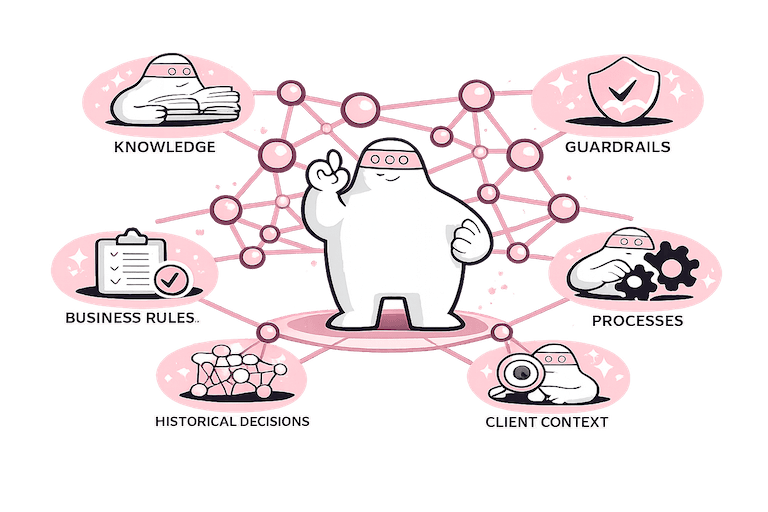
What is a Context Graph?
A Context Graph is a persistent, structured representation of facts, relationships, rules, exceptions, and decision traces that an AI agent can query before it acts. It stores typed entities, explicit connections, temporal validity windows, and provenance metadata in an isolated, per agent namespace.
It is not just a chat log, session memory, or a vector store: it can capture personal working memory, with optional team sharing. It is the reasoning substrate that makes agent actions verifiable and auditable.
The core idea: applicability
Most agent failures are not caused by missing information. They are caused by using the wrong information at the wrong time. A Context Graph is designed to answer one question reliably:
Which context is allowed, valid, and relevant for this action right now?
What the Context Graph provides.
Applicability
Retrieval is filtered by what is relevant to the current action, not by embedding similarity. The graph uses type, scope, permissions, relationship paths, and current validity to produce action aware recall. Your agent gets the right context for this decision, now.
Temporal validity
Time is a first class dimension. Policies change, contracts expire, exceptions are temporary. Each fact carries a validity window, and can be superseded or revoked. Expired, superseded, or revoked facts are excluded from recall automatically. No stale context reaches the agent, and reproducibility stays possible.
Scope isolation
Each agent ID maps to an isolated graph namespace. No shared state between agents or tenants unless explicitly configured. Personal memory stays private by default, and only shared with a team when you choose to. Enforced at infrastructure level. This prevents cross agent leakage that can happen in shared retrieval stores.
Provenance and audit trail
Every fact is traceable to its source, timestamp, and the agent or service that wrote it. You can audit any decision back to the data that informed it, including what was considered applicable at decision time.
Four MCP primitives. One reasoning loop.
The Context Graph exposes four tool calls via MCP (Model Context Protocol). Any MCP compatible client can connect with a single config file.
remember: Store structured facts
Write entities, attributes, and metadata to the graph. Each fact carries provenance (source, timestamp) and an optional validity window.
Provenance and auditability from the first write.
relate: Map explicit relationships
Connect facts to each other with typed edges. The graph captures causal chains, dependencies, and hierarchies, not just flat key value pairs.
Applicability: relationships define what context is relevant to what.
recall: Retrieve applicable context
Query the graph for the context that is applicable to a specific action, right now. Recall respects validity windows, scope boundaries, and relationship paths.
Temporal validity: expired or superseded facts are excluded automatically.
invalidate: Revoke what is no longer true
Mark facts as expired, superseded, or revoked. Downstream relations update accordingly. Agents never act on stale context.
Scope isolation: invalidation is scoped to the agent or tenant namespace.
Store, relate, recall in three calls.
Context Graph MCP
Store · Relate · Recall, 3 calls
mcp.call("remember", { … })Built for enterprise agent workloads.
Each use case maps directly to Rippletide Enterprise Use Cases, where you can explore partner integrations and governance capabilities.
Customer Support Agents
Governed decisions for refunds, exceptions, and commitments.
- Retrieve applicable customer context (history, entitlements, policies) before every action.
- Invalidate superseded commitments so agents never reference expired offers.
- Full audit trail for disputes and compliance.
Coding Agents
Governed code and UI generation constrained by patterns and policy.
- Store and recall personal coding memory (style and habits), optional team-shared preferences, and company best-practice code conventions.
- Relate new code decisions to existing architectural patterns.
- Enforce consistency across projects with scoped, versioned context.
Cybersecurity Incident Response
Governed isolate, block, and revoke with thresholds and audit.
- Recall severity baselines, blast radius thresholds, and prior incident context.
- Invalidate stale threat intelligence before automated response.
- Post incident auditability with full decision provenance.
Background Agents and AI Analysts
Accountable analysis with versioned assumptions and traceability.
- Store versioned assumptions and causal reasoning chains.
- Recall only currently valid data points when generating insights.
- Trace every conclusion back to its source facts and relationships.
Frequently asked questions.
Common questions about the Context Graph. Need more detail? Talk to our team
A Context Graph is structured, typed, and queryable context designed for reliable decision making, not just conversation continuity. Unlike chat memory (usually untyped text), a Context Graph stores facts as entities plus relationships plus provenance plus validity, so agents can retrieve exactly the relevant context for a decision, avoid mixing unrelated sessions or users, enforce freshness and revocation, and produce auditable explanations for actions.
Similarity search answers: what looks semantically close? Applicability answers: what is allowed, valid, and relevant to this action right now? For sensitive actions (refunds, approvals, account changes), semantic similarity can surface plausible but wrong context. A Context Graph adds constraints (type, scope, permissions, recency, status) so recall is gated by correctness, not just relevance.
Start with a small ontology. Entities: Customer, Account, Contract, Ticket, User, Tool, Policy. Relationships: owns, is_authorized_for, relates_to, governed_by, depends_on. Facts: typed statements with provenance plus timestamps. Keep the graph clean by storing atomic facts (one claim per node or edge), using stable identifiers (external IDs where possible), separating policy and constraints from observations, and defining retrieval intents (what an agent needs for each action).
Every fact can carry validity metadata (created_at, valid_from, valid_to, expiry, source). When recalling context for an action, the system can filter by time window (only facts valid now), most recent wins (supersession), status based rules (for example contract_active must be current), and source confidence (CRM system of record over inferred text). This makes stale context a first class failure mode you can prevent systematically.
Invalidation marks a fact as no longer eligible for recall (revoked, expired, superseded). From that point, retrieval excludes it by default, dependent reasoning can be recomputed based on your rules, and audit logs preserve history (who or what invalidated it and why). So you get both: no stale recalls in production, and full traceability for investigations.
Isolation is enforced through scoping: each fact is written with a tenant or agent scope, reads are filtered by that scope (and optionally by role and permissions), and the API enforces access boundaries so agents cannot query outside allowed context. In practice, this prevents cross tenant spillover issues common in shared retrieval.
Each fact can carry: source (system, tool, document, user), timestamps (created, updated, validity), writer (which agent or service wrote it), confidence or evidence links (optional), and relation paths (how this context connects to the decision). When an agent acts, you can reconstruct what it recalled, which constraints applied, and which nodes directly supported the action, giving you a clear why with an audit trail.
MCP integration is designed to be drop in: your agent keeps its framework, and MCP provides tools to manage context safely. Core primitives: remember (write a typed fact), relate (connect entities or facts), recall (retrieve applicable context for an intent or action), invalidate (revoke or supersede outdated facts). Adopt it incrementally: start by writing key entities and facts, recall context for one high value action, add invalidation rules as you learn failure modes, then expand to more actions and policies.
Go deeper.
Context Graph for Agents
Verifiable context. Reliable actions.
Give your agents structured, auditable context with temporal validity and scope isolation. Get started with the docs or talk to our team about your architecture.
- Applicability over similarity retrieval
- Temporal validity on every fact
- Per agent scope isolation
- Full provenance and audit trail