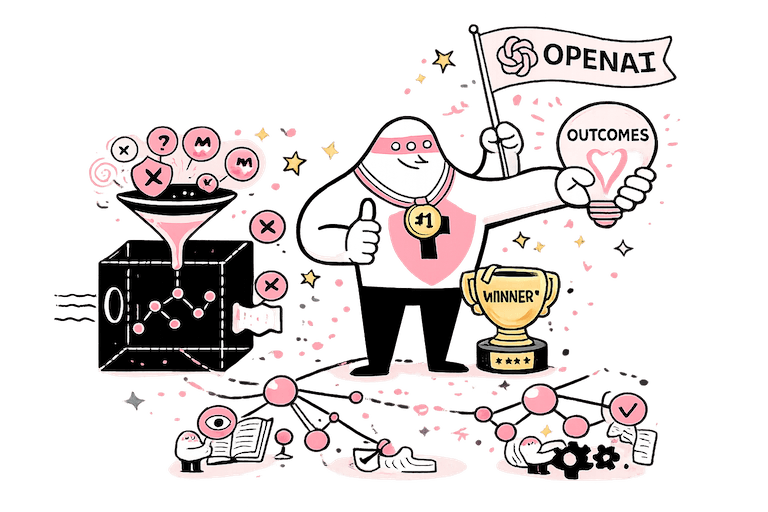
OpenAI Codex executes software engineering tasks autonomously: multi-file edits, refactors, test generation, and iterative bug fixes in a cloud sandbox.
Rippletide ensures every generated change aligns with your engineering standards, validates constraints before merge, and produces a structured trace for every decision.
Decision governance for coding agents means enforcing conventions, validating architectural constraints, and tracing every code generation decision before it reaches production.
Winner, OpenAI Codex Hackathon
Trusted by teams building governed coding agents. Read the story
When AI Writes 40% of Your Code, What Breaks?
Invisible Architectural Drift
Generated code silently deviates from established patterns, creating technical debt that compounds across repositories.
Silent Regressions
Changes pass tests individually but violate cross-module invariants that only surface in production.
Convention Entropy
Naming, structure, and design system rules erode as each coding session starts without memory of prior decisions.
No Decision Memory
Every Codex session starts from zero. Past architectural choices, rejected approaches, and team preferences are lost.
What Codex Delivers
Autonomous task execution in a cloud sandbox
Multi-file edits and refactors
Test writing and iterative correction loops
Parallel task handling across branches
What the Context Graph Adds
Persistent engineering memory across sessions
Convention enforcement (style, naming, patterns)
Architectural constraint validation before merge
Decision traceability for every generated change
Governance workflows: approve, escalate, or block
Memory Hierarchy for Coding Agents
Rippletide operationalizes coding memory in three deterministic layers so Codex can adapt to individual preferences without violating team and company standards.
1. Personal Memory
Developer-level preferences such as naming habits, refactor style, and component composition choices.
2. Team Conventions
Shared repository patterns, review rules, testing expectations, and reusable design system conventions.
3. Company Policies
Security controls, architecture boundaries, compliance constraints, and approval workflows across all teams.
Conflict resolution is explicit and deterministic: company > team > personal.
Auto-apply: change is compatible with all three layers
Escalate: change is valid but requires reviewer approval
Block: change violates company policy or mandatory constraints
Use Case 1 | Code Like Your Team
Convention Enforcement at Scale
The Context Graph stores your team's engineering DNA: naming conventions, component patterns, design system rules, and preferred architectures. Codex inherits this memory before writing a single line.
Style and naming rules applied consistently across every session
Design system constraints enforced on generated UI components
Architectural patterns preserved across repositories and teams
New engineers onboard faster: Codex plus Context Graph equals immediate productivity with team standards
Use Case 2 | Catch Regressions Before Merge
Pre-Merge Validation Against Constraints
Before any generated code reaches your main branch, Rippletide validates it against architectural constraints, cross-module invariants, and security patterns.
Constraint validation against established module boundaries
Insufficient coverage → test policy gate → request changes
Decision outcomes stay explicit: approve, request changes, or escalate to reviewer.
Use Case 3 | Scale Coding Agents Safely
Multi-Agent Governance for Engineering Teams
When multiple Codex instances run in parallel across your organization, consistency becomes critical. The Context Graph provides shared engineering memory so every agent operates under the same standards.
Onboard new agents instantly with structured engineering memory
Consistent governance across parallel Codex sessions
Centralized policy updates propagate to all active agents
Structured audit trail across every agent, every decision, every repository
Codex generates code: autonomous execution within the governed context
Deterministic validation layer: generated output validated against constraints
Feedback loop: revise (back to step 4), escalate to human review, or approve
Decision trace stored: structured record of context, constraints applied, validation results, and outcome
The loop between steps 4 and 6 ensures Codex iterates until the output meets governance criteria, or escalates when it cannot.
Your Standards Should Not Reset When the Model Changes
Codex versions evolve. Foundation models get upgraded. Your engineering conventions, architectural constraints, and governance rules should remain stable through every change.
The Context Graph externalizes engineering memory from model weights. Conventions persist across Codex updates, model provider switches, and multi-provider deployments. Your standards are infrastructure, not prompts.
1. Audit Logs
Structured decision traces for every code generation event, queryable and exportable.
2. Access Control
Repository and module-level permissions enforced before code generation begins.
3. Approval Workflows
Configurable escalation paths for security-sensitive or high-impact changes.
4. Change Tracking
Every constraint modification, convention update, and policy change is versioned and traceable.
5. Structured Decision History
Compliance and engineering leadership receive structured evidence for every autonomous coding decision.
Decision Traceability for Engineering Leadership
Engineering leaders can inspect every governed change by looking at context used, constraints evaluated, checks executed, and final decision outcomes. This enables audit-ready governance without slowing down coding velocity.
Regression Rate
Baseline: last 30 days pre-rollout
Target: quarter-over-quarter reduction
Owner: Engineering productivity
Window: weekly review
PR Review Cycle Time
Baseline: median review duration by repo
Target: faster cycle time without quality drop
Owner: Platform engineering
Window: weekly review
Convention Compliance
Baseline: current violation rate by standard
Target: sustained downward trend
Owner: Tech leads
Window: sprint review
Onboarding Velocity
Baseline: time-to-first approved production PR
Target: shorter ramp while preserving standards
Owner: Engineering management
Window: monthly review
Frequently Asked Questions
What is OpenAI Codex?
OpenAI Codex is an autonomous coding agent that executes software engineering tasks in a cloud sandbox, including multi-file edits, test generation, and iterative bug fixes.
Why do coding agents need governance?
Autonomous code generation at scale introduces architectural drift, silent regressions, and convention entropy. Governance ensures every change is validated against engineering standards before production.
How does the Context Graph work with Codex?
The Context Graph injects persistent engineering memory (conventions, architectural constraints, security patterns) into each Codex session so generated code aligns with team standards.
Can conventions survive model upgrades?
Yes. Engineering memory is externalized in the Context Graph, not embedded in model weights. Conventions persist across Codex versions and model updates.
How do teams measure the impact of governed coding agents?
Teams track regression rate reduction, PR review cycle time, convention compliance rate, and time-to-productivity for new engineers. The structured decision trace provides audit-ready data for each metric.
From Hackathon to Production Infrastructure
Rippletide won the OpenAI Codex Hackathon by demonstrating how decision governance transforms AI outputs into accountable outcomes.